
If you try to access Stake.com from London, Manchester, or anywhere else in Britain today, you are met with a digital wall.
For many punters, this creates a confusing contradiction. You see the Stake logo on Premier League shirts every weekend. You see Formula 1 cars branded with their name racing at Silverstone. You see global celebrities promoting the platform on social media. Yet, when you try to place a bet or spin a slot, you are told it is illegal.
The reason for this is not simple. Stake did not just “leave” the UK market; it was effectively forced out following a perfect storm of regulatory failures, a controversial advertising scandal that made national headlines, and the total collapse of the licensing infrastructure they relied on.
This definitive guide explains exactly why Stake is banned in the UK as of 2026. We will break down the specific incidents that triggered the shutdown, the “white label” house of cards that fell, and why the Gambling Commission (UKGC) refuses to grant a licence to the crypto giant.
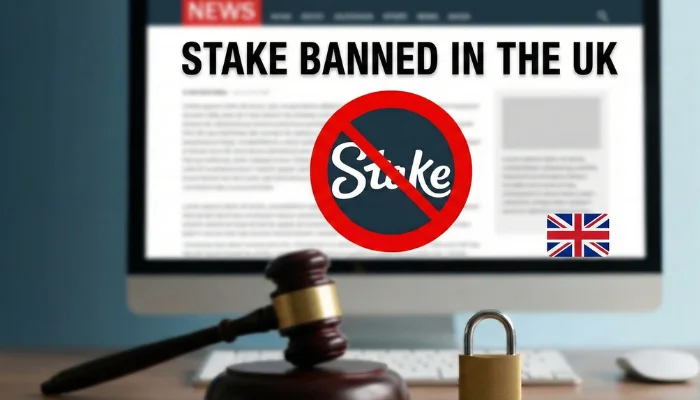
Why is Stake Banned in the UK?
Stake is banned in the UK due to regulatory issues, including non compliance with local gambling laws and failure to obtain the necessary licenses.
As a result, Stake was prohibited from offering its services to UK residents. The UK Gambling Commission requires operators to adhere to specific guidelines regarding customer verification, fair play, and responsible gambling practices, which Stake failed to meet.
Timeline of Stake’s UK Departure (2021 to 2026):
| Year | Key Event and Impact |
| 2021 | Stake enters the UK market via a white label partnership with TGP Europe. The site launches as Stake.uk.com, offering a stripped down version with no crypto capabilities. |
| 2022 | Stake signs a massive sponsorship deal with Everton FC, significantly raising its profile among British football fans despite the product limitations. |
| 2023 | TGP Europe (the licence holder) is fined £316,250 by the UKGC. The regulator cites serious failures in Anti Money Laundering (AML) and social responsibility checks. |
| 2024 | The global Stake.com site continues to grow rapidly, while the UK site struggles to gain market share due to poor odds and the lack of crypto options. |
| Late 2024 / Early 2025 | The “Bonnie Blue” advertising scandal breaks. A viral video links Stake branding to sexual content and targeting students, drawing immediate regulatory ire. |
| February 2025 | The UK Gambling Commission opens a formal investigation into TGP Europe regarding the advertisement and broader compliance issues. |
| March 2025 | Stake.uk.com announces it will stop accepting new registrations as regulatory pressure mounts. |
| May 2025 | TGP Europe surrenders its UK licence. Stake.uk.com goes offline permanently, ending the brand’s legal presence in Britain. |
| 2026 | Stake remains active globally but is strictly blocked in the UK. The brand continues to sponsor Everton until the end of the 2025/26 season. |
The “Bonnie Blue” Advertising Scandal:
While regulatory tension between Stake and the UK authorities had been building for years, the final nail in the coffin was a specific marketing disaster that occurred in early 2025.
Stake.uk.com (the now defunct UK version of the site) came under intense fire after a viral video appeared on social media featuring an adult film star known as “Bonnie Blue.”
The Video That Went Viral:
The video, which circulated widely on X (formerly Twitter) and TikTok, featured the actress standing outside Nottingham Trent University. In the clip, she was soliciting male students for explicit content creation. Crucially, the video was edited to prominently display the Stake.com logo as a watermark, and it was shared by accounts affiliated with Stake’s aggressive social media marketing network.
This was not just a “bad ad.” It was a Public Relations catastrophe that violated the most sacred rules of British advertising standards.
Breaking the CAP Code:
The Gambling Commission and the Advertising Standards Authority (ASA) enforce strict codes known as the CAP Code. The Bonnie Blue incident appeared to violate two specific, non negotiable rules:
- By filming outside a university, the content was seen as directly targeting young people and students, a demographic considered “at risk” for gambling harm.
- UK law strictly forbids suggesting that gambling can enhance your personal qualities or be linked to seduction.
The regulator launched an immediate investigation. They demanded that Stake and its licence holder, TGP Europe, explain how such a breach of “social responsibility” occurred. The backlash was severe, with Members of Parliament citing the video as proof that crypto casinos were out of control. Facing potential licence suspension and massive fines, the decision was made to cease operations before the regulator could revoke the licence forcibly.
The Structural Failure:
To understand the ban fully, you must understand that Stake never actually held its own licence in the UK.
Instead, they operated under a “White Label” agreement. This is a common but risky business structure where a company rents a licence from a third party provider.
What is a White Label Licence?
In the UK, obtaining a full gambling licence is difficult, expensive, and takes years. To bypass this, foreign companies like Stake pay a fee to a UK company that already holds a licence.
In this case, the licence holder was TGP Europe.
- Stake provided the brand, the marketing, and the website design.
- TGP Europe provided the legal paperwork and was responsible for compliance (checking IDs, preventing money laundering, and ensuring fair play).
TGP Europe was the “shield” that allowed Stake to operate legally. When that shield broke, Stake was exposed.
TGP’s History of Regulatory Failures:
TGP Europe was already on thin ice before the Bonnie Blue scandal. In 2023, the Gambling Commission fined TGP Europe £316,250 for significant failures. The regulator found that TGP was not doing enough to check where players’ money was coming from (Anti Money Laundering checks) and was failing to intervene when players showed signs of addiction.
Following the 2025 scandal, the UKGC made it clear that TGP’s “white label” model was under existential threat. Rather than facing a larger investigation that could have resulted in multi million pound fines, TGP Europe surrendered its licence.
This was a “kill switch” for every brand under their umbrella. It wasn’t just Stake that went down; other Asian facing betting sites operating under TGP also lost their UK legal status overnight.
The Fundamental Conflict:
The most common question players ask is: “Why doesn’t Stake just apply for a new licence directly and come back?”
The answer lies in the fundamental mismatch between the business model of Stake.com and the laws of the United Kingdom. Stake is a Crypto Casino. The UKGC is a Fiat Regulator.
The Problem with Anonymous Money:
Stake.com’s global success is built on the speed and relative anonymity of cryptocurrency. You can deposit Bitcoin, Ethereum, or Dogecoin instantly from anywhere in the world.
The UKGC views this as a major risk. Their regulations require operators to verify the “Source of Funds” (SOF) for every player who spends a significant amount.
- Fiat World: If you deposit £5,000 via a debit card, the casino can ask for a bank statement to prove you earned that money legally.
- Crypto World: If you deposit 0.5 Bitcoin, it is very difficult to prove where that money came from. It could be from a job, or it could be the proceeds of crime washed through a “crypto mixer.”
Because Stake cannot easily verify the source of crypto funds to the standard the UKGC demands, they cannot get a licence.
Source of Funds:
The UKGC has become stricter on affordability checks in recent years. They require operators to intervene if a player loses as little as £500 in a short period. Operators must ask for payslips or tax returns.
Stake’s global VIP programme is famous for allowing high rollers to wager millions without question asked. This “no friction” VIP experience is incompatible with UK law. If Stake operated legally in the UK, they would have to ban their biggest spenders or force them to submit piles of paperwork, effectively destroying the product that makes them popular.
Economic Realities:
There is also a cold, hard financial reason for Stake’s exit: The UK is an expensive place to do business.
The Point of Consumption Tax (POCT)
The UK government charges a 21% Point of Consumption Tax on all gross gambling yield. This means that for every £100 Stake keeps in profit from UK players, they have to give £21 to the Treasury immediately.
This is on top of:
- Corporation tax.
- Levies for gambling addiction charities.
- Compliance costs (hiring compliance officers, paying for ID checks).
Compare this to markets like Curacao (where Stake is licensed globally) or emerging markets in Latin America. In Brazil, for example, the regulations are newer, and the market is growing rapidly.
Stake made a strategic calculation. The UK market is “saturated” (everyone already has a Bet365 or Sky Bet account) and expensive. It was simply not profitable enough to jump through the hoops of obtaining a new licence, paying high taxes, and dealing with constant bad press.
The Everton Paradox:
The most confusing part of this ban for the average football fan is the continued visibility of the brand.
“If Stake is banned, why is their logo on the Everton shirt?”
This is due to a specific loophole in the Gambling Act and the timing of Premier League regulations.
Why Everton and F1 Still Carry the Stakes Logo?
Companies are allowed to advertise in the UK even if they do not operate there, provided the specific brand they are advertising is technically a “free to play” educational site, or if the sponsorship deal was signed under previous regulations.
Stake often directs its UK advertising to “Stake.net” or similar free to play portals that do not involve real money gambling. This allows them to keep their logo on television screens legally.
Furthermore, Stake is not paying millions of pounds just to reach Everton fans on Merseyside. The Premier League is the most watched sports league in the world. When Everton plays Arsenal, millions of people are watching in Brazil, Canada, Japan, and Nigeria are the countries where sports betting is legal.
The UK audience is effectively “collateral damage.” Stake uses the UK based team to advertise to the rest of the world.
Sponsorship Ban:
This visibility has an expiry date. Premier League clubs have collectively agreed to ban gambling companies from the front of matchday shirts starting from the 2026/27 season (beginning July 2026).
This means that while you might still see Stake on the sleeves or advertising boards, the days of the massive “STAKE.COM” logo dominating the Premier League are numbered. This impending ban made the UK market even less attractive for Stake to fight for.
Player Safety:
One of the less discussed but critical reasons for the ban is the issue of “Self Exclusion.”
In the UK, all legal gambling sites must join GamStop. This is a national database that allows an addicted gambler to ban themselves from all UK sites with one click. If you are on GamStop, you cannot sign up to Bet365, William Hill, or any legal site.
Stake.com (the global site) is not on GamStop.
The Role of GamStop in the Ban:
Regulators view sites outside of GamStop as predatory. They attract players who have already admitted they have a problem and have blocked themselves from legal sites.
When the UKGC realised that Stake.uk.com (which was on GamStop) was effectively acting as a gateway brand that led players to search for Stake.com (which is NOT on GamStop), they viewed it as a major safety flaw.
By banning Stake entirely, the regulator hopes to protect vulnerable players who use the brand to bypass their self exclusion.
Will We Ever See a Legal Stake UK Again?
As of late 2026, a return looks highly unlikely.
The relationship between Stake’s parent company (Easygo) and the UK regulator is severely damaged. The “Bonnie Blue” scandal showed a lack of control over marketing, and the crypto issue remains unsolved at the government level.
For Stake to return, one of two things must happen:
- The UK Legalises Crypto Gambling: The government would need to pass new laws treating crypto assets as valid funds for gambling, allowing operators to verify wallets rather than bank accounts. This is not currently on the legislative agenda.
- Stake Abandons Crypto for the UK: Stake would need to build a completely separate, “boring,” fiat only site (again) and run it themselves with their own licence. Given the failure of their last attempt, they have little appetite for this.
Conclusion:
Stake is banned in the UK not because of a single error, but because of a fundamental mismatch between their “move fast” crypto culture and the UK’s strict “safety first” regulations.
The closure was triggered by the reckless marketing incident at Nottingham Trent University, but it was cemented by the collapse of their licence holder, TGP Europe. The economics of the UK market—with high taxes and strict player checks—simply did not make sense for a company that makes its billions in unregulated crypto markets.
Until British law catches up with blockchain technology, Stake will remain a brand you can see on a shirt, but never on your screen.
FAQs:
Why did Stake get banned in the UK?
Stake was forced to close its UK site after a regulatory investigation into a controversial social media ad featuring an adult film star, combined with the surrender of the licence by its operating partner, TGP Europe.
Is it illegal to use Stake in the UK with a VPN?
It is not a criminal offence for you to play, but it is a violation of Stake’s Terms of Service. While you won’t be arrested, Stake will ban your account and confiscate your funds if they detect you are playing from the UK.
Why is Stake still on the Everton shirt if it is banned?
Sponsorship laws are different from operating laws. Stake uses the Everton shirt to advertise to global audiences (outside the UK) who watch the Premier League. The deal was signed before the ban and is valid until the end of the 2025/26 season.
Did Stake lose its licence?
Stake never held its own licence; it used a “white label” provider called TGP Europe. TGP Europe surrendered its licence in 2025 following regulatory pressure, which forced Stake UK to close.
Is Stake rigged?
No. Stake.com uses “Provably Fair” technology for its original games, allowing players to verify the randomness of every outcome on the blockchain. However, because it is unregulated in the UK, independent British auditors do not verify their RTP (Return to Player) percentages.
